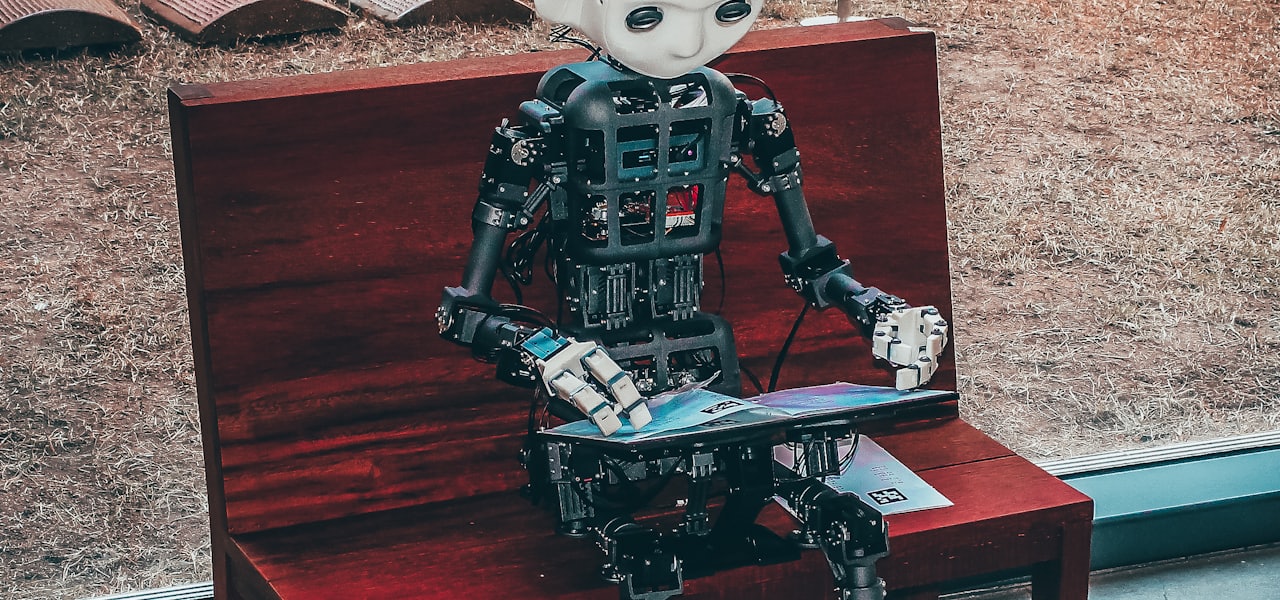
Meta-learning is a subfield of machine learning where automatic learning algorithms are applied to metadata about machine learning experiments. As of 2017, the term had not found a standard interpretation, however the main goal is to use such metadata to understand how automatic learning can become flexible in solving learning problems, hence to improve the performance of existing learning algorithms or to learn (induce) the learning algorithm itself, hence the alternative term learning to learn. Flexibility is important because each learning algorithm is based on a set of assumptions about the data, its inductive bias. This means that it will only learn well if the bias matches the learning problem. A learning algorithm may perform very well in one domain, but not on the next. This poses strong restrictions on the use of machine learning or data mining techniques, since the relationship between the learning problem (often some kind of database) and the effectiveness of different learning algorithms is not yet understood. By using different kinds of metadata, like properties of the learning problem, algorithm properties (like performance measures), or patterns previously derived from the data, it is possible to learn, select, alter or combine different learning algorithms to effectively solve a given learning problem. Critiques of meta-learning approaches bear a strong resemblance to the critique of metaheuristic, a possibly related problem. A good analogy to meta-learning, and the inspiration for Jürgen Schmidhuber's early work (1987) and Yoshua Bengio et al.'s work (1991), considers that genetic evolution learns the learning procedure encoded in genes and executed in each individual's brain. In an open-ended hierarchical meta-learning system using genetic programming, better evolutionary methods can be learned by meta evolution, which itself can be improved by meta meta evolution, etc. == Definition == A proposed definition for a meta-learning system combines three requirements: The system must include a learning subsystem. Experience is gained by exploiting meta knowledge extracted in a previous learning episode on a single dataset, or from different domains. Learning bias must be chosen dynamically. Bias refers to the assumptions that influence the choice of explanatory hypotheses and not the notion of bias represented in the bias-variance dilemma. Meta-learning is concerned with two aspects of learning bias. Declarative bias specifies the representation of the space of hypotheses, and affects the size of the search space (e.g., represent hypotheses using linear functions only). Procedural bias imposes constraints on the ordering of the inductive hypotheses (e.g., preferring smaller hypotheses). == Common approaches == There are three common approaches: using (cyclic) networks with external or internal memory (model-based) learning effective distance metrics (metrics-based) explicitly optimizing model parameters for fast learning (optimization-based). === Model-Based === Model-based meta-learning models updates its parameters rapidly with a few training steps, which can be achieved by its internal architecture or controlled by another meta-learner model. ==== Memory-Augmented Neural Networks ==== A Memory-Augmented Neural Network, or MANN for short, is claimed to be able to encode new information quickly and thus to adapt to new tasks after only a few examples. ==== Meta Networks ==== Meta Networks (MetaNet) learns a meta-level knowledge across tasks and shifts its inductive biases via fast parameterization for rapid generalization. === Metric-Based === The core idea in metric-based meta-learning is similar to nearest neighbors algorithms, which weight is generated by a kernel function. It aims to learn a metric or distance function over objects. The notion of a good metric is problem-dependent. It should represent the relationship between inputs in the task space and facilitate problem solving. ==== Convolutional Siamese Neural Network ==== Siamese neural network is composed of two twin networks whose output is jointly trained. There is a function above to learn the relationship between input data sample pairs. The two networks are the same, sharing the same weight and network parameters. ==== Matching Networks ==== Matching Networks learn a network that maps a small labelled support set and an unlabelled example to its label, obviating the need for fine-tuning to adapt to new class types. ==== Relation Network ==== The Relation Network (RN), is trained end-to-end from scratch. During meta-learning, it learns to learn a deep distance metric to compare a small number of images within episodes, each of which is designed to simulate the few-shot setting. ==== Prototypical Networks ==== Prototypical Networks learn a metric space in which classification can be performed by computing distances to prototype representations of each class. Compared to recent approaches for few-shot learning, they reflect a simpler inductive bias that is beneficial in this limited-data regime, and achieve satisfied results. === Optimization-Based === What optimization-based meta-learning algorithms intend for is to adjust the optimization algorithm so that the model can be good at learning with a few examples. ==== LSTM Meta-Learner ==== LSTM-based meta-learner is to learn the exact optimization algorithm used to train another learner neural network classifier in the few-shot regime. The parametrization allows it to learn appropriate parameter updates specifically for the scenario where a set amount of updates will be made, while also learning a general initialization of the learner (classifier) network that allows for quick convergence of training. ==== Temporal Discreteness ==== Model-Agnostic Meta-Learning (MAML) is a fairly general optimization algorithm, compatible with any model that learns through gradient descent. ==== Reptile ==== Reptile is a remarkably simple meta-learning optimization algorithm, given that both of its components rely on meta-optimization through gradient descent and both are model-agnostic. == Examples == Some approaches which have been viewed as instances of meta-learning: Recurrent neural networks (RNNs) are universal computers. In 1993, Jürgen Schmidhuber showed how "self-referential" RNNs can in principle learn by backpropagation to run their own weight change algorithm, which may be quite different from backpropagation. In 2001, Sepp Hochreiter & A.S. Younger & P.R. Conwell built a successful supervised meta-learner based on Long short-term memory RNNs. It learned through backpropagation a learning algorithm for quadratic functions that is much faster than backpropagation. Researchers at Deepmind (Marcin Andrychowicz et al.) extended this approach to optimization in 2017. In the 1990s, Meta Reinforcement Learning or Meta RL was achieved in Schmidhuber's research group through self-modifying policies written in a universal programming language that contains special instructions for changing the policy itself. There is a single lifelong trial. The goal of the RL agent is to maximize reward. It learns to accelerate reward intake by continually improving its own learning algorithm which is part of the "self-referential" policy. An extreme type of Meta Reinforcement Learning is embodied by the Gödel machine, a theoretical construct which can inspect and modify any part of its own software which also contains a general theorem prover. It can achieve recursive self-improvement in a provably optimal way. Model-Agnostic Meta-Learning (MAML) was introduced in 2017 by Chelsea Finn et al. Given a sequence of tasks, the parameters of a given model are trained such that few iterations of gradient descent with few training data from a new task will lead to good generalization performance on that task. MAML "trains the model to be easy to fine-tune." MAML was successfully applied to few-shot image classification benchmarks and to policy-gradient-based reinforcement learning. Variational Bayes-Adaptive Deep RL (VariBAD) was introduced in 2019. While MAML is optimization-based, VariBAD is a model-based method for meta reinforcement learning, and leverages a variational autoencoder to capture the task information in an internal memory, thus conditioning its decision making on the task. When addressing a set of tasks, most meta learning approaches optimize the average score across all tasks. Hence, certain tasks may be sacrificed in favor of the average score, which is often unacceptable in real-world applications. By contrast, Robust Meta Reinforcement Learning (RoML) focuses on improving low-score tasks, increasing robustness to the selection of task. RoML works as a meta-algorithm, as it can be applied on top of other meta learning algorithms (such as MAML and VariBAD) to increase their robustness. It is applicable to both supervised meta learning and meta reinforcement learning. Discovering meta-knowledge works by inducing knowledge
Natural language processing
Natural language processing (NLP) is the processing of natural language information by a computer. NLP is a subfield of computer science and is closely associated with artificial intelligence. NLP is also related to information retrieval, knowledge representation, computational linguistics, and linguistics more broadly. Major processing tasks in an NLP system include: speech recognition, text classification, natural language understanding, and natural language generation. == History == Natural language processing has its roots in the 1950s. Already in 1950, Alan Turing published an article titled "Computing Machinery and Intelligence," which proposed what is now called the Turing test as a criterion of intelligence, though at the time that was not articulated as a problem separate from artificial intelligence. The proposed test includes a task that involves the automated interpretation and generation of natural language. === Symbolic NLP (1950s – early 1990s) === The premise of symbolic NLP is often illustrated using John Searle's Chinese room thought experiment: Given a collection of rules (e.g., a Chinese phrasebook, with questions and matching answers), the computer emulates natural language understanding (or other NLP tasks) by applying those rules to the data it confronts. 1950s: The Georgetown experiment in 1954 involved fully automatic translation of more than sixty Russian sentences into English. The authors claimed that within three or five years, machine translation would be a solved problem. However, real progress was much slower, and after the ALPAC report in 1966, which found that ten years of research had failed to fulfill the expectations, funding for machine translation was dramatically reduced. Little further research in machine translation was conducted in America (though some research continued elsewhere, such as Japan and Europe) until the late 1980s when the first statistical machine translation systems were developed. 1960s: Some notably successful natural language processing systems developed in the 1960s were SHRDLU, a natural language system working in restricted "blocks worlds" with restricted vocabularies, and ELIZA, a simulation of Rogerian psychotherapy, written by Joseph Weizenbaum between 1964 and 1966. Despite using minimal information about human thought or emotion, ELIZA was able to produce interactions that appeared human-like. When the "patient" exceeded the very small knowledge base, ELIZA might provide a generic response, for example, responding to "My head hurts" with "Why do you say your head hurts?". Ross Quillian's successful work on natural language was demonstrated with a vocabulary of only twenty words, because that was all that would fit in a computer memory at the time. 1970s: During the 1970s, many programmers began to write "conceptual ontologies", which structured real-world information into computer-understandable data. Examples are MARGIE (Schank, 1975), SAM (Cullingford, 1978), PAM (Wilensky, 1978), TaleSpin (Meehan, 1976), QUALM (Lehnert, 1977), Politics (Carbonell, 1979), and Plot Units (Lehnert 1981). During this time, the first chatterbots were written (e.g., PARRY). 1980s: The 1980s and early 1990s mark the heyday of symbolic methods in NLP. Focus areas of the time included research on rule-based parsing (e.g., the development of HPSG as a computational operationalization of generative grammar), morphology (e.g., two-level morphology), semantics (e.g., Lesk algorithm), reference (e.g., within Centering Theory) and other areas of natural language understanding (e.g., in the Rhetorical Structure Theory). Other lines of research were continued, e.g., the development of chatterbots with Racter and Jabberwacky. An important development (that eventually led to the statistical turn in the 1990s) was the rising importance of quantitative evaluation in this period. === Statistical NLP (1990s–present) === Up until the 1980s, most natural language processing systems were based on complex sets of hand-written rules. Starting in the late 1980s, however, there was a revolution in natural language processing with the introduction of machine learning algorithms for language processing. This shift was influenced by increasing computational power (see Moore's law) and a decline in the dominance of Chomskyan linguistic theories (e.g. transformational grammar), whose theoretical underpinnings discouraged the sort of corpus linguistics that underlies the machine-learning approach to language processing. 1990s: Many of the notable early successes in statistical methods in NLP occurred in the field of machine translation, due especially to work at IBM Research, such as IBM alignment models. These systems were able to take advantage of existing multilingual textual corpora that had been produced by the Parliament of Canada and the European Union as a result of laws calling for the translation of all governmental proceedings into all official languages of the corresponding systems of government. However, many systems relied on corpora that were specifically developed for the tasks they were designed to perform. This reliance has been a major limitation to their broader effectiveness and continues to affect similar systems. Consequently, significant research has focused on methods for learning effectively from limited amounts of data. 2000s: With the growth of the web, increasing amounts of raw (unannotated) language data have become available since the mid-1990s. Research has thus increasingly focused on unsupervised and semi-supervised learning algorithms. Such algorithms can learn from data that has not been hand-annotated with the desired answers or using a combination of annotated and non-annotated data. Generally, this task is much more difficult than supervised learning, and typically produces less accurate results for a given amount of input data. However, large quantities of non-annotated data are available (including, among other things, the entire content of the World Wide Web), which can often make up for the worse efficiency if the algorithm used has a low enough time complexity to be practical. 2003: word n-gram model, at the time the best statistical algorithm, is outperformed by a multi-layer perceptron (with a single hidden layer and context length of several words, trained on up to 14 million words, by Bengio et al.) 2010: Tomáš Mikolov (then a PhD student at Brno University of Technology) with co-authors applied a simple recurrent neural network with a single hidden layer to language modeling, and in the following years he went on to develop Word2vec. In the 2010s, representation learning and deep neural network-style (featuring many hidden layers) machine learning methods became widespread in natural language processing. This shift gained momentum due to results showing that such techniques can achieve state-of-the-art results in many natural language tasks, e.g., in language modeling and parsing. This is increasingly important in medicine and healthcare, where NLP helps analyze notes and text in electronic health records that would otherwise be inaccessible for study when seeking to improve care or protect patient privacy. == Approaches: Symbolic, statistical, neural networks == Symbolic approach, i.e., the hand-coding of a set of rules for manipulating symbols, coupled with a dictionary lookup, was historically the first approach used both by AI in general and by NLP in particular: such as by writing grammars or devising heuristic rules for stemming. Machine learning approaches, which include both statistical and neural networks, on the other hand, have many advantages over the symbolic approach: both statistical and neural network methods tend to focus more on the most common cases extracted from a corpus of texts, whereas the rule-based approach needs to provide rules for both rare and common cases equally. language models, produced by either statistical or neural networks methods, are more robust to both unfamiliar (e.g. containing words or structures that have not been seen before) and erroneous input (e.g. with misspelled words or words accidentally omitted) in comparison to the rule-based systems, which are also more costly to produce. the larger such a (probabilistic) language model is, the more accurate it becomes, in contrast to rule-based systems that can gain accuracy only by increasing the amount and complexity of the rules leading to intractability problems. Rule-based systems are commonly used: when the amount of training data is insufficient to successfully apply machine learning methods, e.g., for the machine translation of low-resource languages such as provided by the Apertium system, for preprocessing in NLP pipelines, e.g., tokenization, or for post-processing and transforming the output of NLP pipelines, e.g., for knowledge extraction from syntactic parses. === Statistical approach === In the late 1980s and mid-1990s, the statistical approach ended a peri
Muller automaton
In automata theory, a Muller automaton is a type of an ω-automaton. The acceptance condition separates a Muller automaton from other ω-automata. The Muller automaton is defined using a Muller acceptance condition, i.e. the set of all states visited infinitely often must be an element of the acceptance set. Both deterministic and non-deterministic Muller automata recognize the ω-regular languages. They are named after David E. Muller, an American mathematician and computer scientist, who invented them in 1963. == Formal definition == Formally, a deterministic Muller-automaton is a tuple A = (Q,Σ,δ,q0,F) that consists of the following information: Q is a finite set. The elements of Q are called the states of A. Σ is a finite set called the alphabet of A. δ: Q × Σ → Q is a function, called the transition function of A. q0 is an element of Q, called the initial state. F is a set of sets of states. Formally, F ⊆ P(Q) where P(Q) is powerset of Q. F defines the acceptance condition. A accepts exactly those runs in which the set of infinitely often occurring states is an element of F In a non-deterministic Muller automaton, the transition function δ is replaced with a transition relation Δ that returns a set of states and the initial state q0 is replaced by a set of initial states Q0. Generally, 'Muller automaton' refers to a non-deterministic Muller automaton. For more comprehensive formalisation look at ω-automaton. == Equivalence with other ω-automata == The Muller automata are equally expressive as parity automata, Rabin automata, Streett automata, and non-deterministic Büchi automata, to mention some, and strictly more expressive than the deterministic Büchi automata. The equivalence of the above automata and non-deterministic Muller automata can be shown very easily as the accepting conditions of these automata can be emulated using the acceptance condition of Muller automata and vice versa. McNaughton's theorem demonstrates the equivalence of non-deterministic Büchi automaton and deterministic Muller automaton. Thus, deterministic and non-deterministic Muller automata are equivalent in terms of the languages they can accept. == Transformation to non-deterministic Muller automata == Following is a list of automata constructions that each transforms a type of ω-automata to a non-deterministic Muller automaton. From Büchi automata If B is the set of final states in a Büchi automaton with the set of states Q, we can construct a Muller automaton with same set of states, transition function and initial state with the Muller accepting condition as F = { X | X ∈ P(Q) ∧ X ∩ B ≠ ∅}. From Rabin automata/parity automata Similarly, the Rabin conditions ( E j , F j ) {\displaystyle (E_{j},F_{j})} can be emulated by constructing the acceptance set in the Muller automaton as all sets F ⊆ Q {\displaystyle F\subseteq Q} that satisfy F ∩ E j = ∅ {\displaystyle F\cap E_{j}=\emptyset } and F ∩ F j ≠ ∅ {\displaystyle F\cap F_{j}\neq \emptyset } , for some j. Note that this covers the case of parity automata too, as the parity acceptance condition can be expressed as a Rabin acceptance condition easily. From Streett automata The Streett conditions ( E j , F j ) {\displaystyle (E_{j},F_{j})} can be emulated by constructing the acceptance set in the Muller automaton as all sets F ⊆ Q {\displaystyle F\subseteq Q} that satisfy F ∩ F j = ∅ ⟹ F ∩ E j = ∅ {\displaystyle F\cap F_{j}=\emptyset \implies F\cap E_{j}=\emptyset } , for all j. == Transformation to deterministic Muller automata == From Büchi automaton McNaughton's theorem provides a procedure to transform any non-deterministic Büchi automaton into a deterministic Muller automaton.
EuroMatrixPlus
The EuroMatrixPlus is a project that ran from March 2009 to February 2012. EuroMatrixPlus succeeded a project called EuroMatrix (September 2006 to February 2009) and continued in further development and improvement of machine translation (MT) systems for languages of the European Union (EU). == Project objectives == EuroMatrixPlus focused on achieving several goals: To continue advance of MT technology (create MT systems for all official EU languages and provide other MT researchers with existing data and infrastructure). To continually expand and investigate different MT approaches and techniques; to stay open to novel combinations of methods of MT. To bring MT to the users. Users post-edit output of statistical models and the system learns from the feedback and improves itself. Two groups of users were aimed at: Professional translators and translation agencies Users who voluntarily translate texts into their native language To contribute to MT research in Europe. To produce sample application for automatic translation of news and web pages and make that application freely accessible. == Outcome == EuroMatrixPlus contributed to MT field in several ways. It continued in development of an open source statistical MT engine Moses. The project worked on research in hybrid approaches to MT (combination of rule-based and statistical techniques). Several “MT Marathons” and annual evaluation campaigns were organized by the project. The project also resulted in releasing of 196 scientific publications. The results of the work were arranged into ten work packages: WP1: Rich Tree-Based Statistical Translation WP2: Hybrid Machine Translation WP3: Advanced Learning Methods for MT WP4: Open Source Tools and Data WP5: "WikiTrans" Translation Environments WP6: Integrated Localisation Workflow WP7: Evaluation Campaign WP8: Project Management and Dissemination WP9: Integrating Slovak Language Resources WP10: HPSG-based Statistical Translation === Software and data === Here is a list of software and data that were released by the project: Appraise – an open source tool for manual evaluation of MT output BURGER – Bulgarian Resource BulTreeBank – Treebank of Bulgarian CSLM toolkit – free tool for training continuous space language models (CSLM) to large tasks Caitra – tool for post-editing MT results Europarl – European Parliament parallel corpus IRSTLM toolkit – tool for training language models Joshua – an open-source statistical machine translation decoder for hierarchical and syntax-based MT MT Server Land – an open-source architecture for MT Moses – statistical MT MultiUN Corpora – parallel corpus extracted from the United Nations Website PCEDT 2.0 – Prague Czech-English Dependency Treebank PEDT 2.0 – English part of the Prague Czech-English Dependency Treebank Slovak corpora – English-Slovak and Czech-Slovak as well as a Slovak-English and a Slovak-Czech parallel corpus Slovak treebank – A dependency treebank TermEx – RBMT-Suited Statistical Terminology Extraction Tool Treex, TectoMT == Funding == The EuroMatrixPlus project was sponsored by EU Information Society Technology program. Total cost of the project was 5 942 121 €, from which the European Union contributed 4 266 896 €. == Project members == To ensure advance in MT, several organizations that are experts in various disciplines (linguistics, computer science, mathematics, translation) were brought together to cooperate on EuroMatrixPlus. The consortium consisted of academic as well as commercial partners. Academic partners were the University of Edinburgh (United Kingdom), DFKI – German Research Centre for Artificial Intelligence (Germany), Charles University (Czech Republic), Johns Hopkins University (United States), University of Le Mans (France), Fondazione Bruno Kessler (Italy), Dublin City University (Ireland). Two institutions joined about one year into the project. These were the L'udovít Štúr Institute of Linguistics (Slovak Republic) and IICT – Institute of Information and Communication Technologies at the Bulgarian Academy of Sciences (Bulgaria). Commercial partners included Lucy Software and Services GmbH (Germany) and CEET s.r.o. (Czech Republic). Coordination of the project was in hands of DFKI with its Language Technology Lab in Saarbrücken. The principal investigator and scientific coordinator was Hans Uszkoreit, a professor of Computational Linguistics at Saarland University.
Ω-automaton
In automata theory, a branch of theoretical computer science, an ω-automaton (or stream automaton) is a variation of a finite automaton that runs on infinite, rather than finite, strings as input. Since ω-automata do not stop, they have a variety of acceptance conditions rather than simply a set of accepting states. ω-automata are useful for specifying behavior of systems that are not expected to terminate, such as hardware, operating systems and control systems. For such systems, one may want to specify a property such as "for every request, an acknowledge eventually follows", or its negation "there is a request that is not followed by an acknowledge". The former is a property of infinite words: one cannot say of a finite sequence that it satisfies this property. Classes of ω-automata include the Büchi automata, Rabin automata, Streett automata, parity automata and Muller automata, each deterministic or non-deterministic. These classes of ω-automata differ only in terms of acceptance condition. They all recognize precisely the regular ω-languages except for the deterministic Büchi automata, which is strictly weaker than all the others. Although all these types of automata recognize the same set of ω-languages, they nonetheless differ in succinctness of representation for a given ω-language. == Deterministic ω-automata == Formally, a deterministic ω-automaton is a tuple A = ( Q , Σ , δ , q 0 , A a c c ) {\textstyle A=(Q,\Sigma ,\delta ,q_{0},A_{acc})} , that consists of the following components: Q {\textstyle Q} , is a finite set. The elements of Q {\textstyle Q} are called the states of A {\textstyle A} . Σ {\textstyle \Sigma } , is a finite set called the alphabet of A {\textstyle A} . δ : Q × Σ → Q {\textstyle \delta \colon Q\times \Sigma \rightarrow Q} is a function, called the transition function of A {\textstyle A} . Q 0 {\textstyle Q_{0}} is an element of Q {\textstyle Q} , called the initial state. A a c c {\textstyle A_{acc}} is a set of accepting states of A {\textstyle A} , formally a subset of Q ω {\textstyle Q^{\omega }} . An input for A {\textstyle A} is an infinite string over the alphabet Σ {\textstyle \Sigma } , i.e. it is an infinite sequence α = ( a 1 , a 2 , a 3 , … ) {\textstyle \alpha =(a_{1},a_{2},a_{3},\ldots )} . The run of A {\textstyle A} on such an input is an infinite sequence ρ = ( r 0 , r 1 , r 2 , … ) {\textstyle \rho =(r_{0},r_{1},r_{2},\ldots )} of states, defined as follows: r 0 = q 0 {\textstyle r_{0}=q_{0}} . r 1 = δ ( r 0 , a 1 ) {\textstyle r_{1}=\delta (r_{0},a_{1})} . r 2 = δ ( r 1 , a 2 ) {\textstyle r_{2}=\delta (r_{1},a_{2})} . ... that is, for every i {\textstyle i} : r i = δ ( r i − 1 , a i ) {\textstyle r_{i}=\delta (r_{i-1},a_{i})} . The main purpose of an ω-automaton is to define a subset of the set of all inputs: The set of accepted inputs. Whereas in the case of an ordinary finite automaton every run ends with a state r n {\textstyle r_{n}} and the input is accepted if and only if r n {\textstyle r_{n}} is an accepting state, the definition of the set of accepted inputs is more complicated for ω-automata. Here we must look at the entire run ρ {\textstyle \rho } . The input is accepted if the corresponding run is in Acc {\textstyle {\text{Acc}}} . The set of accepted input ω-words is called the recognized ω-language by the automaton, which is denoted as L ( A ) {\textstyle L(A)} . The definition of Acc {\textstyle {\text{Acc}}} as a subset of Q ω {\textstyle Q^{\omega }} is purely formal and not suitable for practice because normally such sets are infinite. The difference between various types of ω-automata (Büchi, Rabin etc.) consists in how they encode certain subsets Acc {\textstyle {\text{Acc}}} of Q ω {\textstyle Q^{\omega }} as finite sets, and therefore in which such subsets they can encode. == Nondeterministic ω-automata == Formally, a nondeterministic ω-automaton is a tuple A = ( Q , Σ , Δ , Q 0 , Acc ) {\textstyle A=(Q,\Sigma ,\Delta ,Q_{0},{\text{Acc}})} that consists of the following components: Q {\textstyle Q} is a finite set. The elements of Q {\textstyle Q} are called the states of A {\textstyle A} . Σ {\textstyle \Sigma } is a finite set called the alphabet of A {\textstyle A} . Δ {\textstyle \Delta } is a subset of Q × Σ × Q {\textstyle Q\times \Sigma \times Q} and is called the transition relation of A {\textstyle A} . Q 0 {\textstyle Q_{0}} is a subset of Q {\textstyle Q} , called the initial set of states. Acc {\textstyle {\text{Acc}}} is the acceptance condition, a subset of Q ω {\textstyle Q^{\omega }} . Unlike a deterministic ω-automaton, which has a transition function δ {\textstyle \delta } , the non-deterministic version has a transition relation Δ {\textstyle \Delta } . Note that Δ {\textstyle \Delta } can be regarded as a function Q × Σ → P ( Q ) {\textstyle Q\times \Sigma \rightarrow {\mathcal {P}}(Q)} from Q × Σ {\textstyle Q\times \Sigma } to the power set P ( Q ) {\textstyle {\mathcal {P}}(Q)} . Thus, given a state q n {\textstyle q_{n}} and a symbol a n {\textstyle a_{n}} , the next state q n + 1 {\textstyle q_{n+1}} is not necessarily determined uniquely, rather there is a set of possible next states. A run of A {\textstyle A} on the input α = ( a 1 , a 2 , a 3 , … ) {\textstyle \alpha =(a_{1},a_{2},a_{3},\ldots )} is any infinite sequence ρ = ( r 0 , r 1 , r 2 , … ) {\textstyle \rho =(r_{0},r_{1},r_{2},\ldots )} of states that satisfies the following conditions: r 0 {\textstyle r_{0}} is an element of Q 0 {\textstyle Q_{0}} . r 1 {\textstyle r_{1}} is an element of Δ ( r 0 , a 1 ) {\textstyle \Delta (r_{0},a_{1})} . r 2 {\textstyle r_{2}} is an element of Δ ( r 1 , a 2 ) {\textstyle \Delta (r_{1},a_{2})} . ... that is, for every i {\textstyle i} : r i {\textstyle r_{i}} is an element of Δ ( r i − 1 , a i ) {\textstyle \Delta (r_{i-1},a_{i})} . A nondeterministic ω-automaton may admit many different runs on any given input, or none at all. The input is accepted if at least one of the possible runs is accepting. Whether a run is accepting depends only on Acc {\textstyle {\text{Acc}}} , as for deterministic ω-automata. Every deterministic ω-automaton can be regarded as a nondeterministic ω-automaton by taking Δ {\textstyle \Delta } to be the graph of δ {\textstyle \delta } . The definitions of runs and acceptance for deterministic ω-automata are then special cases of the nondeterministic cases. == Acceptance conditions == Acceptance conditions may be infinite sets of ω-words. However, people mostly study acceptance conditions that are finitely representable. The following lists a variety of popular acceptance conditions. Before discussing the list, let's make the following observation. In the case of infinitely running systems, one is often interested in whether certain behavior is repeated infinitely often. For example, if a network card receives infinitely many ping requests, then it may fail to respond to some of the requests but should respond to an infinite subset of received ping requests. This motivates the following definition: For any run ρ {\textstyle \rho } , let Inf ( ρ ) {\textstyle {\text{Inf}}(\rho )} be the set of states that occur infinitely often in ρ {\textstyle \rho } . This notion of certain states being visited infinitely often will be helpful in defining the following acceptance conditions. A Büchi automaton is an ω-automaton A {\textstyle A} that uses the following acceptance condition, for some subset F {\textstyle F} of Q {\textstyle Q} : Büchi condition A {\textstyle A} accepts exactly those runs ρ {\textstyle \rho } for which Inf ( ρ ) ∩ F ≠ ∅ {\textstyle {\text{Inf}}(\rho )\cap F\neq \emptyset } , i.e. there is an accepting state that occurs infinitely often in ρ {\textstyle \rho } . A Rabin automaton is an ω-automaton A {\textstyle A} that uses the following acceptance condition, for some set Ω {\textstyle \Omega } of pairs ( B i , G i ) {\textstyle (B_{i},G_{i})} of sets of states: Rabin condition A {\textstyle A} accepts exactly those runs ρ {\textstyle \rho } for which there exists a pair ( B i , G i ) {\textstyle (B_{i},G_{i})} in Ω {\textstyle \Omega } such that B i ∩ Inf ( ρ ) = ∅ {\textstyle B_{i}\cap {\text{Inf}}(\rho )=\emptyset } and G i ∩ Inf ( ρ ) ≠ ∅ {\textstyle G_{i}\cap {\text{Inf}}(\rho )\neq \emptyset } . A Streett automaton is an ω-automaton A {\textstyle A} that uses the following acceptance condition, for some set Ω {\textstyle \Omega } of pairs ( B i , G i ) {\textstyle (B_{i},G_{i})} of sets of states: Streett condition A {\textstyle A} accepts exactly those runs ρ {\textstyle \rho } such that for all pairs ( B i , G i ) {\textstyle (B_{i},G_{i})} in Ω {\textstyle \Omega } , B i ∩ Inf ( ρ ) ≠ ∅ {\textstyle B_{i}\cap {\text{Inf}}(\rho )\neq \emptyset } or G i ∩ Inf ( ρ ) = ∅ {\textstyle G_{i}\cap {\text{Inf}}(\rho )=\emptyset } . A parity automaton is an automaton A {\textstyle A} whose set of states is Q = { 0 , 1 , 2 , … , k } {\textstyle Q=\{0,1,2,\ldots ,k\}} for some natural number k {\textst
Beauty.AI
Beauty.AI is a mobile beauty pageant for humans and a contest for programmers developing algorithms for evaluating human appearance. The mobile app and website created by Youth Laboratories that uses artificial intelligence technology to evaluate people's external appearance through certain algorithms, such as symmetry, facial blemishes, wrinkles, estimated age and age appearance, and comparisons to actors and models. The Beauty.AI 2.0 contest caused great concern over important ethical issues with deep neural networks such as age, race and gender bias and lead to the creation of the Diversity.AI think tank dedicated to developing new methods for uncovering and managing bias in artificially intelligent systems. Beauty.AI was also an attempt to find approaches on how machines can perceive human face through evaluating particular features, commonly associated with health and beauty. == Concept == The Beauty.AI app was created by Youth Laboratories, a company based out of Russia and Hong Kong that focuses on facial skin analytics. The bioinformation company Insilico Medicine assists in the Beauty.AI app by testing its deep learning techniques to the app. One goal of the app is to reduce the need for human and animal testing as well as improving people's overall health. Its first contest was started in December 2016, and the results were announced in August 2016. More than 60,000 people submitted entries into the contest. The mobile app uses artificial intelligence technology to inspect photographs for certain facial features in order to both determine a person's beauty through artificial means by multiple robots. Part of the Beauty.AI app's purpose is to collect visual and anecdotal data to improve its creator's Youth Laboratories skin analyst skills. == Accusations of racism == There were a total of 44 individuals from different age groups and genders judged as the most attractive, with 37 white entrants, six Asian entrants, and one dark-skinned entrant. The app has received criticism from social justice advocates and computer science professionals. However, Alex Zhavoronkov, PhD, chief science officer of Youth Laboratories and chief technology officer Konstantin Kiselev, both for Youth Laboratories, noted that a lack of data may have contributed to these results. Also, Kiselev added that another issue was that approximately 75% of entrants were white Europeans, whereas only 7% and 1% were from India and Africa, respectively. Kiselev stated that they would work on doing more and better outreach to these areas to improve in this area. Despite this, it was said by Dr. Zhavoronkov that the AI would discard photos of dark-skinned people if the lighting is too poor. Dr. Zhavoronkov vowed to weed out the issues for the next beauty pageant and to try to avoid a similar controversy in the future.
AI Website Builders Reviews: What Actually Works in 2026
Trying to pick the best AI website builder? An AI website builder is software that uses machine learning to help you get more done — it scales effortlessly from a single task to thousands. The best picks balance beginner-friendly simplicity with the depth power users need, and they ship updates often. Whether you are a beginner or a pro, the right AI website builder slots into your workflow and pays for itself fast. Read on for hands-on impressions, pricing tiers, and the standout features that matter.